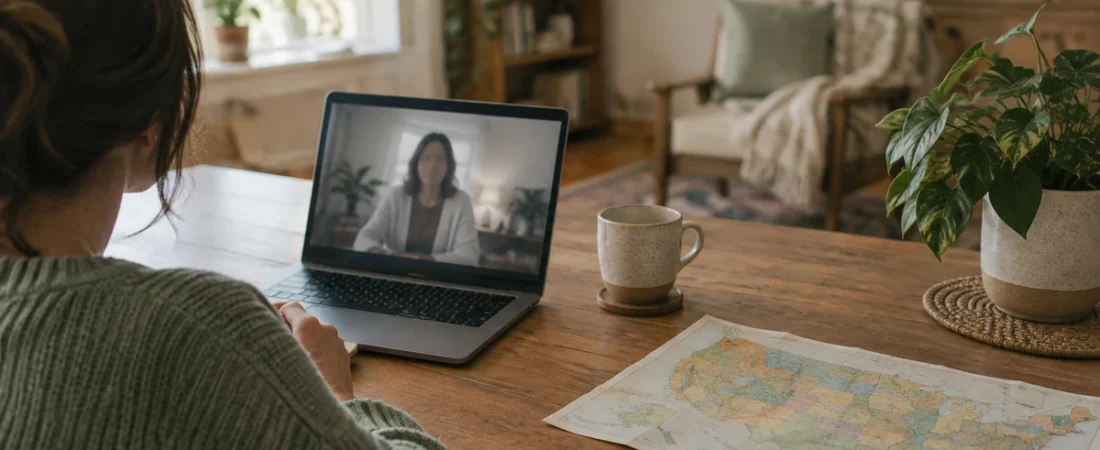
Online therapy crosses state lines easily — but licensing doesn’t. In the US, mental health professionals are licensed by individual states, and telehealth rules generally depend on where the client is located during the session. Here’s what that means for you, and how to check a therapist’s license in the largest states.
Ready to talk to a licensed therapist?
Online-Therapy.com pairs you with a licensed therapist, weekly live sessions by video, voice or text (Standard plan and up), and a step-by-step CBT program. Use code THERAPY20 for 20% off your first month.
Get started with Online-Therapy.com →Sponsored link · Cancel anytime · Not an emergency service — in crisis, call or text 988
Why your state matters
- Therapists are licensed by state boards, and each state sets its own rules for telehealth.
- In general, your therapist should be licensed (or otherwise authorized) to practice in the state where you’re located when you have your session.
- If you move or travel for long periods, tell your therapist — it can affect whether they can keep working with you.
- Insurance networks are also state-specific.
How to verify a therapist’s license
- Ask your therapist for their full name, license type, and license number, and which state issued it.
- Look them up on that state’s licensing board website.
- Check that the license is active and see whether there are any disciplinary actions.
License lookups in the four largest states
| State | Common license types | Where to verify |
|---|---|---|
| California | LMFT, LCSW, LPCC (Board of Behavioral Sciences); psychologists (Board of Psychology) | California Board of Behavioral Sciences |
| Texas | LPC, LMFT, LCSW, psychologists | Texas Behavioral Health Executive Council |
| Florida | LMHC, LMFT, LCSW, psychologists | Florida Department of Health license search |
| New York | LMHC, LMFT, LCSW, psychologists | NYS Office of the Professions verification |
See how it works, step by step
Online-Therapy.com walks you through a short questionnaire, matches you with a licensed therapist, and gives you a structured CBT program. Use code THERAPY20 for 20% off your first month.
See how Online-Therapy.com works →Sponsored link · Cancel anytime · Not an emergency service — in crisis, call or text 988
What this means when you choose a service
National services like Online-Therapy.com, BetterHelp, and Talkspace work across the US. Online-Therapy.com says its therapists hold licenses, certifications, or registrations with recognized professional bodies; after you’re matched, ask your therapist which state they’re licensed in and verify it on the board’s website. It takes two minutes and gives you peace of mind.
Next steps: how to start online therapy · Online-Therapy.com review · insurance guide
Frequently asked questions
Can a therapist in another state see me online?
Generally, therapists need to be licensed or authorized in the state where you’re located during the session. Rules vary by state, so ask your therapist.
How do I check if a therapist is licensed?
Search their name or license number on the licensing board website for the state that issued the license.
What’s the difference between LPC and LMHC?
Both are licensed professional counselors; states use different titles for similar licenses.
Ready to talk to a licensed therapist?
Online-Therapy.com pairs you with a licensed therapist, weekly live sessions by video, voice or text (Standard plan and up), and a step-by-step CBT program. Use code THERAPY20 for 20% off your first month.
Get started with Online-Therapy.com →Sponsored link · Cancel anytime · Not an emergency service — in crisis, call or text 988
Sources
- California Board of Behavioral Sciences
- Texas Behavioral Health Executive Council
- Florida Department of Health: License Verification
- New York State Office of the Professions: License Verification
- Online-Therapy.com FAQ: Who will my therapist be?